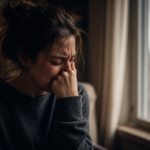


And instead of the relief you expected, you feel… worse. Restless. Agitated. Your mind races through everything you should be doing back home. Your body vibrates with a strange, objectless anxiety. You try to relax by the pool and find yourself composing mental emails. You eat a beautiful meal and barely taste it. By day two, you might even feel physically ill — a headache that won’t shift, a stomach that’s suddenly rebellious, an exhaustion so deep that sleeping twelve hours doesn’t touch it.
You’re on holiday. You’re supposed to feel good. And the fact that you don’t makes you feel like something is fundamentally wrong with you.
Nothing is wrong with you. Something is wrong with your nervous system’s relationship with rest. And understanding that distinction changes everything.
The Neurochemistry of Stopping
When you’ve been running in sympathetic nervous system overdrive for weeks or months — as most working adults in modern life are — your body adapts to that state. Cortisol and adrenaline become your baseline fuel. You’re not thriving on them; you’re surviving on them. But you’re functional, and your entire biochemistry has calibrated itself to this elevated normal.
Think of it like driving at 150 kilometres per hour for so long that 150 starts to feel like 80. You’ve adapted to the speed. Your hands have stopped gripping the wheel so tightly. You’ve forgotten that this isn’t cruising speed — it’s emergency speed. You just can’t feel it anymore because your system has normalised it.
Then you stop. Suddenly. The stressor is removed. And the neurochemical tide retreats. Cortisol plummets. Adrenaline withdraws. The stress hormones that were keeping everything running — masking fatigue, suppressing immune function, overriding pain signals — drop away.
What you feel in their absence is not relaxation. It’s the crash. The headaches, the fatigue, the immune system dips, the digestive issues — these are not new problems. They’re old problems that were being papered over by the chemical scaffolding of chronic stress. The holiday didn’t create them. It revealed them.
Why Stillness Feels Like a Threat
For some people, the difficulty of relaxing on holiday goes deeper than biochemistry. For people with a history of chronic stress, developmental trauma, or early environments where hypervigilance was necessary for survival, stillness itself can feel genuinely dangerous.
This makes sense when you trace it back. If you grew up in a home where unpredictable things happened — a parent’s mood could shift without warning, a moment of calm could be shattered by conflict, letting your guard down meant missing a cue that kept you safe — your nervous system wired itself to equate alertness with survival. Relaxation wasn’t just unfamiliar. It was irresponsible. It was the thing that got you hurt.
That wiring doesn’t automatically rewire because you’re sitting by a pool in Bali. Your body doesn’t consult the environment. It consults its own archive. And the archive says: stillness is when bad things happen. Stay watchful. Stay prepared. Don’t trust this.
This is why some people unconsciously create stress on holiday. They pick a fight with their partner. They check their work emails obsessively. They plan an itinerary so packed that it’s indistinguishable from a work schedule. These behaviours look irrational, but they’re perfectly logical from a nervous system perspective. The system is manufacturing the familiar state of activation because the unfamiliar state of stillness feels unbearable.
The Body’s Honest Report
Here’s the uncomfortable truth that the holiday reveals: you weren’t coping as well as you thought you were. The busy-ness was masking the exhaustion. The productivity was covering the anxiety. The constant movement was preventing you from feeling what was actually happening in your body.
The holiday doesn’t create the problem. It removes the distraction. And without the distraction, the body finally gets a chance to present its honest report. The chronic tension that was being overridden by adrenaline. The sleep debt that was being masked by cortisol. The emotions that were being suppressed by the relentless pace of daily life.
This is why so many people get sick on the first days of a holiday. The immune system, which has been suppressed by chronic stress hormones, suddenly comes back online and deals with all the pathogens it’s been ignoring. It’s not bad timing or bad luck. It’s the body finally being allowed to do its maintenance work.
The Phenomenon of ‘Leisure Sickness’
Researchers have actually studied this phenomenon and given it a name: leisure sickness. Studies suggest that around three percent of the population experiences regular illness at the onset of weekends or holidays, and the actual number is likely higher, since many people experience subtler versions — the headache that arrives on Saturday morning, the fatigue that descends on the first day of annual leave.
The mechanism is straightforward: chronic stress suppresses certain immune functions while keeping you artificially alert and functional. When the stress is removed, the immune system rebounds, inflammation increases, and the body begins processing everything it deferred during the high-stress period. It’s like a city that postponed all its road repairs during a crisis — the moment the crisis ends, every road is under construction simultaneously.
What Your Holiday Inability Is Telling You
The inability to relax on holiday is not a personality quirk. It’s diagnostic information. It’s your nervous system presenting you with an unfiltered readout of its current state, stripped of all the coping mechanisms and distractions that normally buffer it.
If the readout says ‘I can’t stop,’ the question isn’t ‘how do I relax harder?’ The question is: what is my everyday life asking of my nervous system, and is that sustainable?
This is a question most people avoid, because answering it honestly might mean making changes they’re not ready to make. But the body is patient. It will keep sending the same signal — on this holiday, and the next one, and the next one — until the signal is heard.
Learning to Arrive (Slowly)
Instead of expecting to feel relaxed on day one — which sets you up for the shame spiral of ‘I can’t even relax properly’ — give your nervous system a transition period. Budget the first two days as decompression, not relaxation. Expect to feel restless. Expect the mind to race. Expect the body to protest. And let it. Don’t fill the discomfort with activity. Don’t check your emails to soothe the withdrawal. Just be with what’s arising and name it: ‘My nervous system is adjusting. This is the crash. This is normal.’
Bring gentle regulation practices with you. Slow walks. Meals eaten without screens. Warm baths. Conscious breathing in the morning before the day begins. These aren’t luxury add-ons. They’re neurological bridge-building — ways of helping your system move from one gear to another without stalling.
And perhaps most importantly: pay attention to the information the holiday gives you. If your body can’t relax in paradise, the problem isn’t paradise. The problem is the life you’re returning to, or more precisely, the pace at which your nervous system has been forced to operate within that life.
The holiday is a mirror. It shows you the state of your system with the filters removed. The question is whether you’ll look at what it shows you — and whether you’ll let what you see change something.