You learned this phrase early. You probably did not learn it as a phrase. You learned it as a rule. As a way of moving through the world. As a quiet, constant pressure that shaped every interaction you had with anyone older than you — your parents, your aunts, your uncles, your grandparents, your teachers, your father’s friends, your mother’s cousins, the elderly relatives whose names you barely knew but whose feet you were expected to touch.
Respect your elders. Three small words. They sounded harmless. They sounded right. They sounded like something everyone agreed on.
But here is what they often meant, in practice, in a household like the one many of us grew up in.
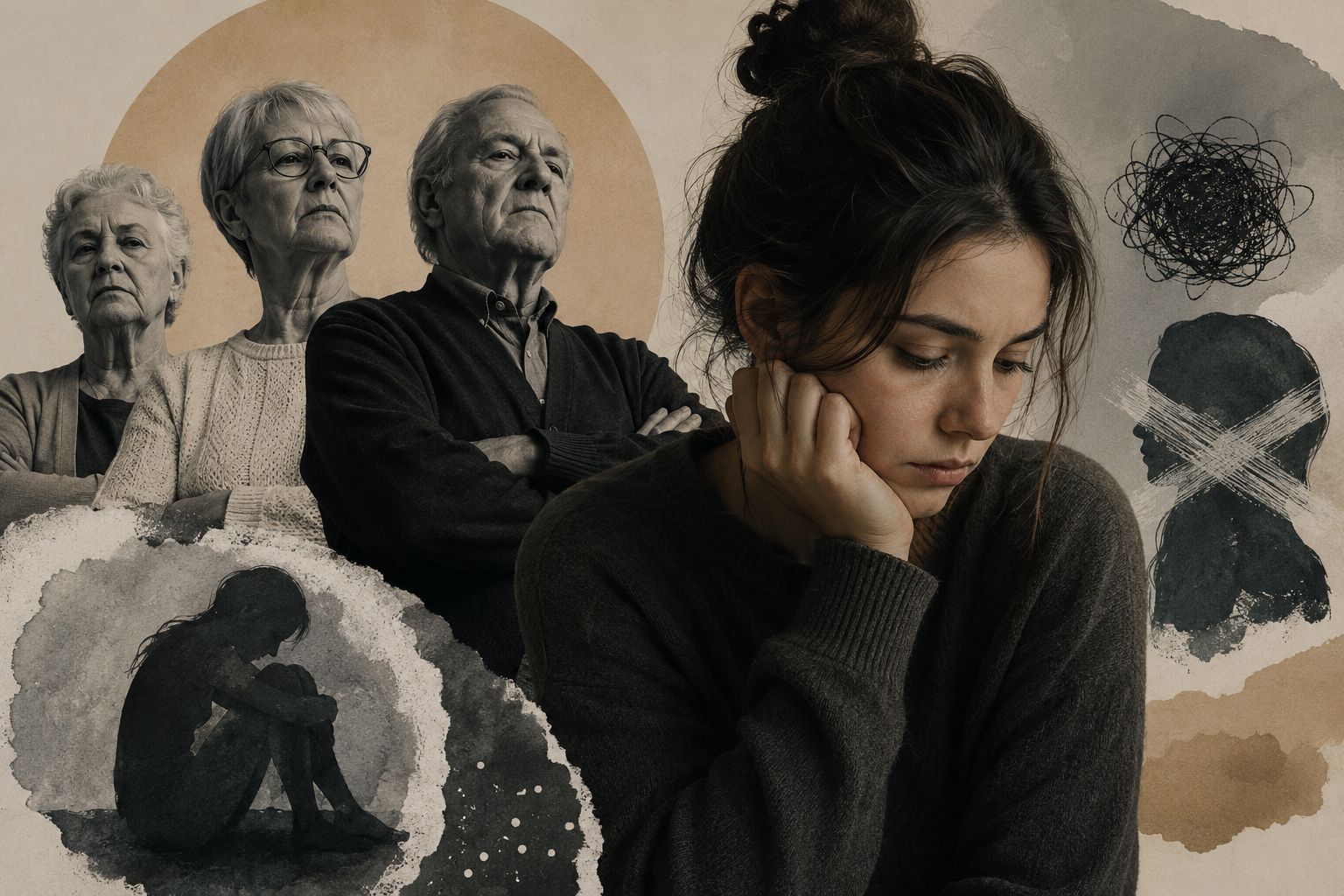
They meant — do not contradict your aunt, even when she says something untrue about you. They meant — do not look upset when your uncle pinches your cheek too hard. They meant — do not say no when your grandfather asks for a kiss. They meant — do not flinch when your mother’s friend tells you that you have put on weight. They meant — do not protest when your father tells the family a story about you that you would never have told yourself.
They meant — your feelings about how you are being treated do not matter, because the person treating you that way is older than you.
I want to be careful here. I am not arguing against respect. Respect for elders, in many cultures, is a beautiful and important value. It connects us to lineage. It honours the people who came before us. It teaches humility. It builds community across generations.
But somewhere along the way, in many of our homes, respect got confused with silence. With self-erasure. With the suppression of our own feelings in order to preserve the dignity, the comfort, the convenience of someone older. This is not what respect actually is. This is something else, wearing the costume of respect.
True respect is mutual. It is reciprocal. It exists between two people who acknowledge each other’s humanity. The version most of us grew up with was not mutual. It was hierarchical. You owed your elders deference. They did not owe you the same.
The Wound That Doesn’t Look Like a Wound
This created, in many of us, a particular kind of wound. A wound that does not look like a wound, because it was inflicted in the name of culture, family, tradition, love. A wound that is so widely held that almost no one calls it a wound. A wound that women, especially, carry through life without knowing they are carrying anything at all.
The wound is this. We learned, very young, that our own emotional signals were not valid in the presence of someone older. We learned that when an uncle made us uncomfortable, our discomfort was the problem, not his behaviour. We learned that when a grandmother criticised us, our hurt was something to swallow. We learned that when a parent did something unkind, our feelings about it had to be set aside, because they were the parent, and we were the child, and there was a hierarchy that explained everything.
The cost of this learning is enormous. It does not stop when you grow up. The pattern is now in your body. It runs automatically.
You walk into a room full of older relatives, and your own sense of self goes quiet. You do not even notice it going quiet. It just goes. You become someone slightly smaller, slightly more performative, slightly more careful with words. You laugh at the joke that is not funny. You smile at the comment that stung. You absorb. You do not register your absorption as absorption. You think it is just being polite.
Then you go home and you wonder why you are so tired. Why your jaw is sore. Why your chest is tight. Why you snap at your partner over something small. You do not connect it to the gathering. The gathering, after all, was fine. Everyone was lovely. You had a nice time.
What you do not see is that you spent the entire gathering disowning small parts of yourself in order to keep the peace.
Multiply that by every gathering. Every visit. Every phone call. Every meal. Every wedding. Every funeral. Every casual drop-in by an older relative. Year after year. Decade after decade.
It adds up. The body keeps count.
I have seen women in their forties who have spent so many years honouring elders that they have forgotten how to honour themselves. They do not know what they want for dinner because for so long they ate what their mother served. They do not know what they like because for so long they liked what their family approved of. They cannot tell whether they are happy in their marriage because for so long their happiness has been calibrated to the comfort of others.
This is not a small thing. This is the slow erosion of a self.
What Healing This Pattern Looks Like
The work of healing this is not easy, because the culture that taught it to you is still alive. Your elders are still elders. The expectation is still there. The family gatherings still happen. You cannot opt out of being in a family. And often, you do not want to. You love your family. You honour your culture. You do not want to throw any of it away.
But you also cannot keep going the way you have been going. Something has to shift.
What does the shift look like?
It begins with permission. Permission to notice that you have feelings, in real time, when older people are doing things you do not like. The feelings are valid. They were always valid. You were taught to override them, but the feelings themselves are not bad. They are accurate. They are data.
When your aunt makes a comment about your body, you are allowed to feel hurt by it. You do not have to feel hurt in front of her. You do not have to confront her. But inside you, the hurt is allowed to exist. You are allowed to register it. To name it. To know that what was said was not okay, regardless of who said it or how senior they are.
When your father tells a story about you that embarrasses you, you are allowed to feel embarrassed. The embarrassment is information. It is telling you that something is happening that you do not like.
When your grandmother insists you eat more even though you are full, you are allowed to feel the resistance in your body. You do not have to refuse her food in a dramatic way. But you are allowed to know, inside yourself, that your fullness is real, and that her insistence is overriding it.
This noticing is the first, smallest, most powerful act of returning to yourself. It does not require any visible action. It only requires that you stop pretending, even silently, that you feel fine when you do not.
Respect Versus Obedience
The second piece is to begin, gently, to let your no exist. Not always out loud. Not always publicly. But sometimes. In small ways. When the older relative asks you to come visit them next weekend and you do not have it in you, you can say no. You do not have to give five reasons. You do not have to apologise three times. You can simply say, that won’t work for me. The world will not end. The relative may be disappointed. You can hold their disappointment without dissolving in it.
The third piece is to begin to differentiate between respect and obedience. You can respect someone deeply and still disagree with them. You can love someone fully and still set a limit with them. You can honour your elders and still know that some of what they did was harmful. These things are not opposites. The version of respect you were taught suggested they were. But that was a narrow definition. The wider definition includes truth.
Becoming the Elder You Needed
The fourth piece, and this is the most important, is to begin to be the elder you would have wanted. The aunt who asks her niece what she wants rather than telling her. The mother who notices her child’s discomfort instead of overriding it. The grandmother who listens to the young people in her family with curiosity instead of correction. This is how the cycle changes. Not by destroying what came before, but by becoming someone different in the role.
You can still love your family. You can still touch the feet of those who taught you. You can still show up to the gatherings and bring the food and play the role. But you do all of it now as someone who has not abandoned herself in the process. As someone whose feelings exist alongside her duties. As someone whose respect is real, because it includes self-respect.
The phrase respect your elders was given to you as a complete sentence. It was not. It was the first half of a sentence. The full sentence is — respect your elders, and yourself.
You are allowed to have both. You were always allowed to have both. The fact that you were taught otherwise is not your fault. But it is now your work to undo. Slowly. Patiently. With love for the family that raised you and love for the self that is finally beginning to come back.
You did not deserve to disappear in order to honour them. You do not need to disappear now. You can stay. Whole. Present. Respectful in the deepest sense — to them, and to the self they did not always know how to see.
The Grief of Seeing Clearly
One last thing, because I think about this often and I want to name it.
There is a quiet grief that comes with this work. A grief that does not have a clear name and does not show up at funerals. It is the grief of realising, in your thirties or forties, that the way you were raised cost you more than anyone acknowledged. It is the grief of looking back at the little girl you were and seeing how much she absorbed. How much she was asked to swallow. How much she shrank.
This grief is real and it deserves to be felt…
Respect Your Elders, and Yourself
Find her. Sit with her. Tell her that her feelings were always real. That what was done to her in the name of respect was sometimes not respect at all. That she is allowed to grow into a woman who does not disappear.
The phrase that was given to you was incomplete. The full version is yours to write. Respect your elders, and yourself. Honour your culture, and your own life inside it. Show up for your family, and for the girl you were who deserved more.
We use cookies to ensure that we give you the best experience on our website. If you continue to use this site we will assume that you are happy with it.Ok