

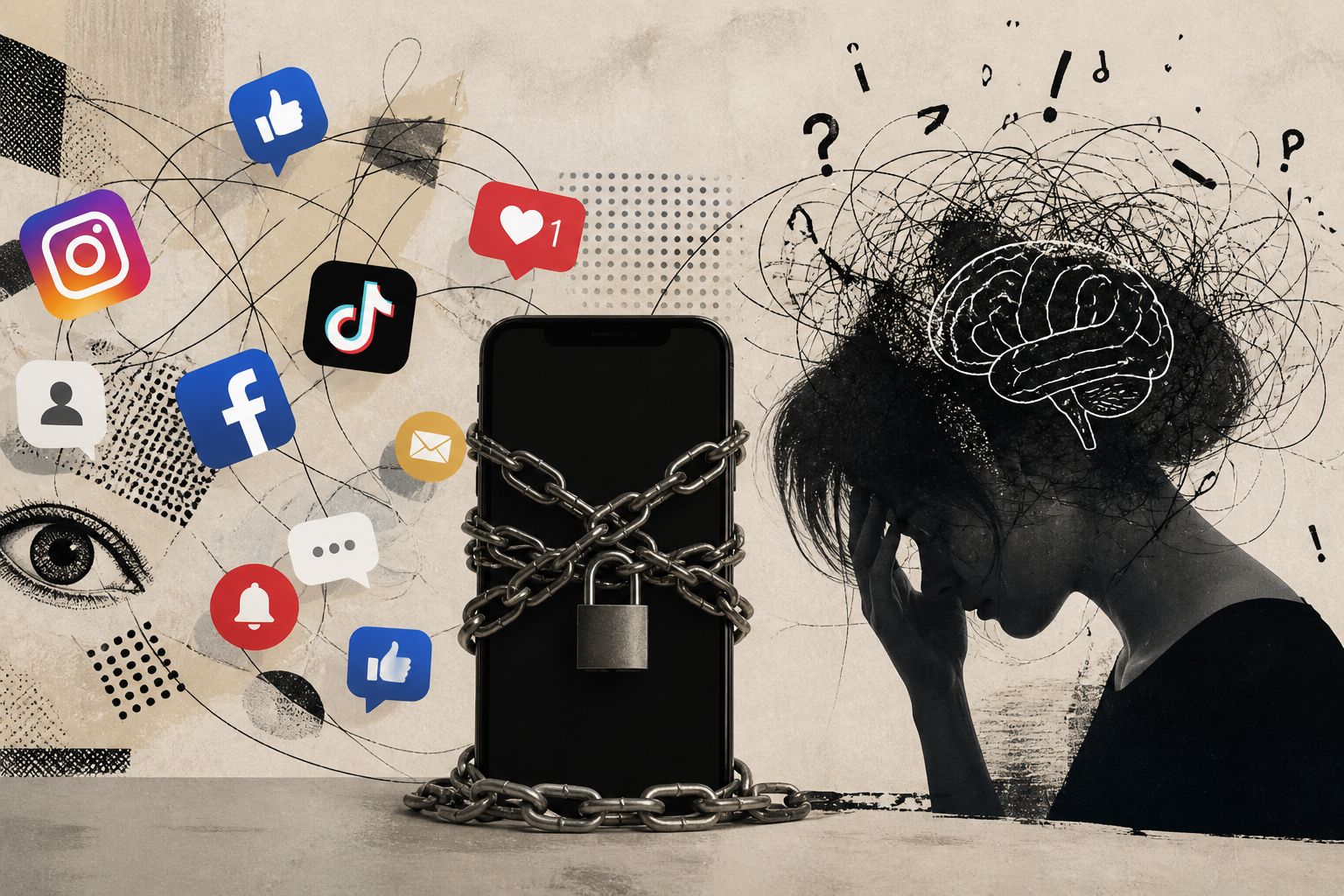
We talk about social media as a willpower issue, a discipline issue, a time management issue. But what if it’s none of those things? What if the real story is happening below the neck in the nervous system, the dopamine pathways, and the ancient biological circuitry that evolved to keep you alive but is now being exploited to keep you engaged?
The Slot Machine in Your Pocket
Social media platforms are not designed to inform you. They are designed to retain you. Every design decision the infinite scroll, the pull-to-refresh gesture, the unpredictable notification timing is borrowed from the psychology of slot machines. And slot machines are the most addictive devices ever invented by humans.
The key mechanism is variable reinforcement. Sometimes you scroll and find something genuinely interesting or pleasurable. Sometimes you find nothing. Sometimes you find something upsetting. The unpredictability is the point. Your brain’s dopamine system doesn’t respond most strongly to rewards it responds most strongly to the anticipation of possible rewards. The ‘maybe’ is more neurologically compelling than the ‘yes.’
So each time you open the app, your dopamine system fires not because something good has happened, but because something good might happen. And when it doesn’t, the system says: try again. One more scroll. The next post. The next notification. It’s the same loop that keeps a gambler at the table. And it’s running in your pocket, twenty-four hours a day.
Scrolling as Nervous System Regulation (That Doesn’t Actually Regulate)
For many people, the phone isn’t really about entertainment or information. It’s about regulation. When you feel anxious, understimulated, emotionally uncomfortable, or simply bored which is itself a nervous system state, not a personality flaw the phone offers a quick exit from that sensation.
The rapid stream of content provides just enough stimulation to override whatever you’re feeling without actually processing it. It’s like putting a plaster over a wound you haven’t cleaned. The bleeding stops for a moment, but the infection underneath continues to grow.
In nervous system terms, this is a form of dissociation. Not the dramatic, clinical dissociation of leaving your body entirely but a low-grade, ambient dissociation. A gentle departure from presence. You’re not really here. You’re not really anywhere. You’re in the scroll that grey twilight zone between engagement and numbness, where nothing is actually being felt, processed, or experienced. Just consumed.
And when you finally put the phone down, you often feel worse than when you picked it up. Not because anything bad happened in those twenty minutes, but because your nervous system was denied the chance to actually process whatever it was trying to process before the scroll intervened. The discomfort is still there. It’s just been postponed and compounded.
The Comparison Engine: Why It Hurts in the Body
Beyond the dopamine mechanics, social media creates a relentless stream of social comparison. And your nervous system takes this personally literally.
Humans evolved in small groups where social status was directly linked to survival. Being part of the group meant access to food, protection, and mates. Being excluded could mean death. This is not ancient history this circuitry is still running. Your nervous system is constantly, unconsciously assessing your social position: Am I valued? Do I belong? Am I keeping up?
Social media feeds this assessment engine a diet of curated highlight reels. You’re not comparing your life to reality you’re comparing your behind-the-scenes to everyone else’s showreel. And your nervous system doesn’t know the difference. It sees the disparity and triggers a genuine stress response: a sinking in the chest, a contraction in the stomach, a heaviness that settles over you like a weather system.
This isn’t just a mindset issue. Comparison triggers the same neurochemical cascade as a genuine social threat. Cortisol rises. The sympathetic system activates. The body prepares for rejection, exclusion, abandonment. All from looking at a stranger’s holiday photos while sitting on your own sofa in your pyjamas.
The Attention Economy and Your Embodied Self
There’s a phrase in the tech industry: ‘the attention economy.’ It refers to the fact that your attention is the product being sold. Platforms compete for it, advertisers pay for it, and algorithms are optimised to capture and hold as much of it as possible.
But attention is not just a resource. It’s a function of the nervous system. It’s how you orient to the world. It’s how you notice beauty, danger, connection, and meaning. When your attention is captured and directed by algorithms for hours each day, something essential is being taken from you not just your time, but your capacity for presence. Your ability to be where you are, in your body, in your life, noticing what’s actually happening around you.
Think of attention as a spotlight. When it’s pointed at a screen, it’s not pointed at the person sitting across from you. It’s not pointed at the sensation in your chest. It’s not pointed at the quality of light outside the window. The cost of the scroll is not just the minutes lost but the moments of embodied experience that were traded for them.
Reclaiming the Nervous System
The goal here is not to demonize technology or demand a digital detox. The goal is to build somatic awareness around your usage to notice what your body is doing before, during, and after you scroll, and to let those signals guide your behavior instead of the algorithm.
Before you pick up the phone, pause. What are you feeling right now? What is the phone being asked to solve? Boredom? Anxiety? Loneliness? Naming the underlying state doesn’t make the urge disappear, but it interrupts the automatic loop. It creates a gap between impulse and action, and in that gap, choice lives.
During scrolling, check in with your body every few minutes. Has your breathing changed? Is your jaw tight? Do you feel more or less settled than before you started? If you notice activation tension, comparison, agitation let that be information, not failure. Your body is telling you something the algorithm never will: this isn’t helping.
After you put the phone down, take a deliberate moment to re-enter your body. Feel your feet on the floor. Take three slow breaths with an extended exhale. Look at something in the room and really see it its color, its texture, its weight. This micro-transition helps your nervous system shift from the disembodied scroll-state back to the embodied present. It’s small, but it’s meaningful. It’s you choosing to come home to yourself.