

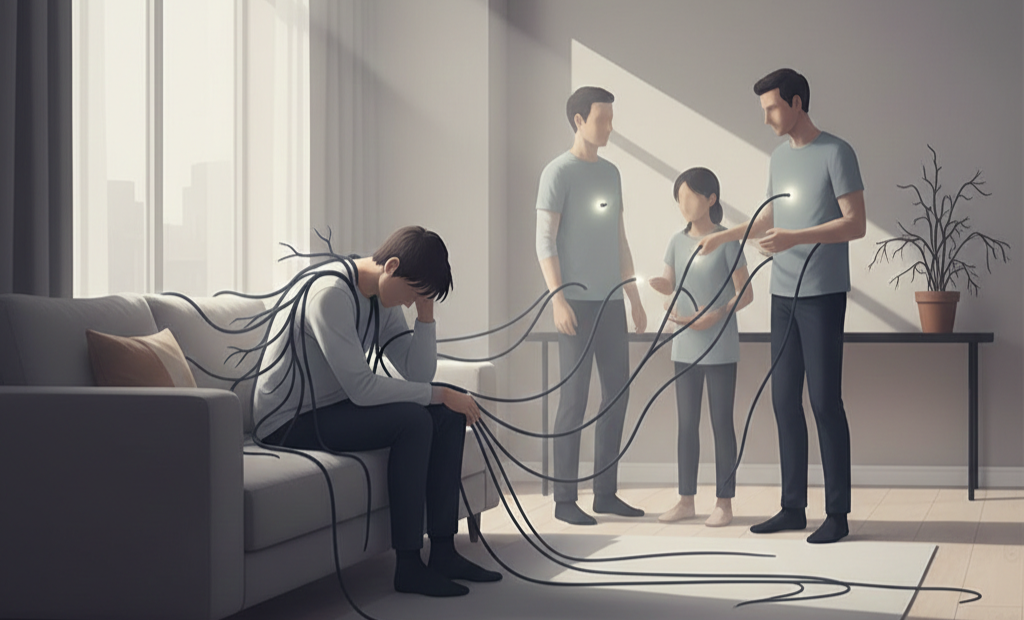
You can attend a work event and feel fine.
But ten minutes into a family gathering and something shifts.
Your shoulders tense.
Your breath shortens.
You feel smaller.
More alert.
More irritated.
Or suddenly quiet and withdrawn.
And afterwards, you’re exhausted.
Not physically tired in a simple way.
But drained.
Heavy.
Like your system ran a marathon you didn’t consciously sign up for.
If this happens to you, it does not automatically mean your family is toxic. Nor does it mean you’re cold, ungrateful, or emotionally immature.
Family activates your nervous system in ways no other relationship can.
Because family is where your nervous system was first shaped.
Family Is Not Just Relationship — It’s History in Real Time
When you’re with family, you are not just interacting with who they are today.
You are interacting with who they were when you were small.
Your body remembers:
- How conflict was handled.
- How emotions were responded to.
- What happened when you needed attention.
- How mistakes were treated.
- Whether you were allowed to have boundaries.
These memories may not be verbal. They may not even be conscious.
But they are encoded physiologically.
The nervous system stores relational patterns through repetition. It builds templates for safety and threat.
When you return to your family environment — even as an adult — those templates reactivate.
You are not just a grown adult visiting home.
Your body is revisiting its original regulatory blueprint.
The Regression Effect
Many adults notice that around family, they feel younger.
More reactive.
More defensive.
More compliant.
Or more rebellious.
This is not imagination.
When you return to an old relational system, especially one that shaped your identity, your nervous system may shift into earlier coping states.
These patterns once protected you.
But activating them requires energy.
And energy expenditure without conscious choice is draining.
Hypervigilance in Familiar Spaces
Family environments often carry subtle unpredictability.
Your nervous system may become hyper-attuned to micro-shifts:
- A tone change.
- A glance.
- A sigh.
This hypervigilance is rarely visible externally.
But internally, it consumes energy.
Your body prepares for potential rupture.
Even if no rupture happens.
This constant scanning is metabolically expensive.
The Weight of Unresolved Roles
Family systems tend to stabilise around roles.
- The achiever.
- The caretaker.
- The mediator.
- The problem child.
- The invisible one.
When you re-enter that system, the role often reactivates automatically.
And maintaining an outdated role is exhausting.
Because it requires self-suppression.
Emotional Labour Without Awareness
You may be:
- Monitoring tension.
- Translating between personalities.
- Preventing arguments.
- Adjusting your tone to avoid escalation.
- Avoiding certain topics.
This emotional management is rarely acknowledged.
But your nervous system is constantly calculating.
Prolonged social regulation without reciprocal attunement leads to depletion.
The Body’s Response to Old Power Dynamics
Your responses are not weakness.
They are implicit memory.
When the context resembles earlier experiences — even subtly — activation occurs.
Why You Can Love Your Family and Still Feel Drained
Love does not cancel nervous system activation.
You can care deeply and still feel dysregulated.
Because the body responds to patterns, not intentions.
Boundaries and Energy Economics
Overriding internal cues repeatedly is exhausting.
When internal signals are ignored, depletion follows.
The Role of Shame
Shame activates dorsal vagal pathways — leading to collapse, heaviness, and withdrawal.
You may leave a gathering feeling inexplicably heavy.
Because your system tightened repeatedly.
The Nervous System Cost of “Being Good”
Self-monitoring consumes cognitive and physiological resources.
Your body prefers coherence.
Fragmentation is expensive.
The Freeze Response in Family Settings
Sometimes you feel numb.
Detached.
Foggy.
This can be a mild freeze response.
Why It’s Worse During Holidays
Holidays intensify family dynamics.
Social engagement requires regulation.
If regulation is already strained, overstimulation compounds exhaustion.
Healing the Drain
Feeling drained is information.
It requires awareness.
You can experiment with:
- Shorter visits.
- Intentional breaks.
- Clearer boundaries.
- Grounding before and after gatherings.
The goal is not to eliminate activation.
It is to increase capacity.
Updating the System
Over time, consistent boundary-setting and self-regulation teach your nervous system something new.
That you are no longer powerless.
Energy expenditure decreases.
When Distance Is Necessary
In some cases, family systems remain chronically unsafe.
Distance is not avoidance.
It is protection.
A Different Question
Instead of asking, “Why am I so drained around them?”
Try asking:
“What does my nervous system have to manage when I’m there?”
Final Reflection
Feeling drained around family is not proof of dysfunction.
It is evidence of activation.
With awareness, regulation, and compassionate boundaries, you can reduce the drain.
You are not the child you once were.
And your body can learn that too.